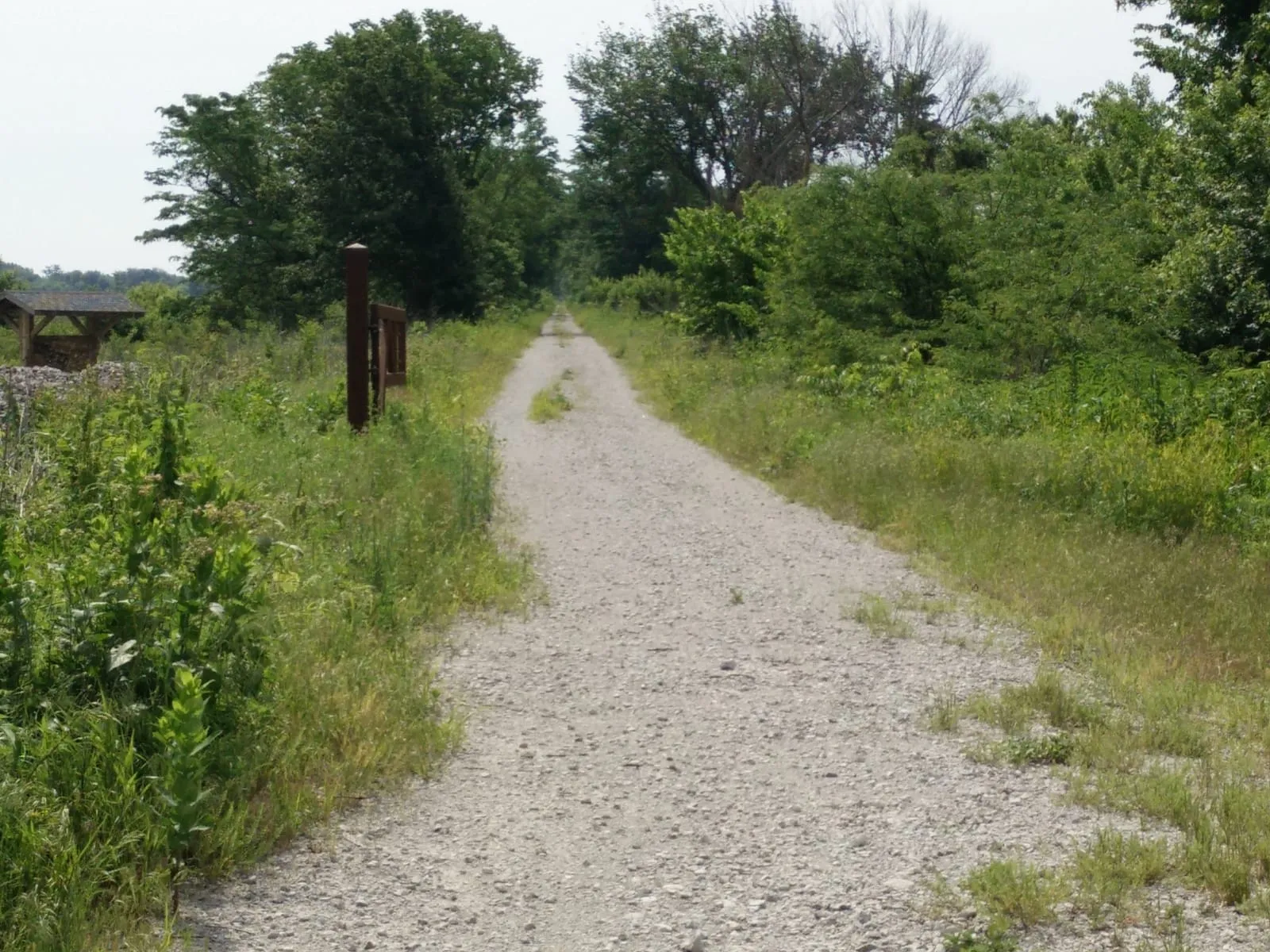

Missouri does something most states don’t: it lets you into its state parks for free [1]. No gate fee, no day pass. That means the only cost of your first hike is showing up.
And Missouri gives you something else that’s gold for beginners: every state park trail has a printed “trail card” with its distance, surface, rating and estimated time [2]. You’ll know exactly what you’re walking into. No surprises. Just you, a trail you can handle, and a reason to come back.
At a glance
- State park entrance fee
- None [1]
- Easiest start
- Braille Trail, Elephant Rocks: 0.9-mi paved loop, easy, about 26 min [2]
- Paved overlook walk
- Castle Trail, Ha Ha Tonka: 0.4 mi one way, accessible [3]
- Paved lakeside stretch
- Spring Trail, Ha Ha Tonka: first 0.4 mi paved [4]
- Goal climb
- 316 wooden steps, 200 vertical feet [4]
Plan your week
| Moderate minutes brisk walk, easy bike | Vigorous minutes run, hard hike, class | Strength | |
|---|---|---|---|
| Mon | |||
| Tue | |||
| Wed | |||
| Thu | |||
| Fri | |||
| Sat | |||
| Sun |
Based on the federal Physical Activity Guidelines for adults: 150 minutes of moderate activity a week (each vigorous minute counts as two), plus muscle-strengthening on at least 2 days. Check with your doctor before starting a new exercise plan, especially if you have a health condition. Plug in the free Missouri spots from this guide.
How to read a Missouri trail card
Missouri State Parks publishes a sheet for every trail. Here’s what’s on it and how to use it [2]:
- Rating: easy, moderate or rugged. Start with easy. Seriously.
- Estimated hiking time: based on an average hiker’s speed and the trail’s conditions. Yours may be slower or faster, and that’s fine.
- Class: a loop brings you back to the start. A one-way (linear) trail doesn’t, so double the distance and time to get back to your car.
- “You may experience”: a numbered list of what’s on the trail, like steps, steep grades, bluffs or stream crossings.
That last one is your best friend. Read it before you go.
Start here: Elephant Rocks State Park
Picture giant granite boulders lined up like a circus train. That’s Elephant Rocks, and the easiest way to see them is the Braille Trail [2].
- 0.9-mile loop, paved, rated easy, about 26 minutes [2].
- Designed in 1981 for people with visual or physical disabilities, it was the first trail of its kind in Missouri state parks and is a National Recreation Trail [2].
- It passes a quarry pond, and a short spur takes you to the top of the granite outcrop, where you can explore the maze of rocks. Another spur overlooks an old quarry where “Missouri Red” granite was cut from the 1860s into the early 1900s [2].
The trail card also lists wood or stone steps, bridges and some bluffs or drop-offs along the way [2]. Stay on the marked path and give bluff edges and quarry drop-offs plenty of room.
This is a perfect first hike. Short, paved, and you get to climb on giant rocks. Do it twice. Bring a friend the second time.
Next: Ha Ha Tonka State Park
Ha Ha Tonka, near Camdenton on the Lake of the Ozarks, has castle ruins, a natural bridge and a huge spring [5]. The park says its trails and boardwalks make it easy to see the highlights [5]. Some of its trails are gentle; some are not. Here’s how to climb through them.
Castle Trail. 0.4 mile one way, paved, and wheelchair and stroller accessible from both castle parking lots [3]. It’s rated moderate because of some steep grades and bluffs or drop-offs [3], but there are 12 benches along the way and on three scenic overlooks of the Lake of the Ozarks [3]. The upper lot has limited parking and is recommended for people with disabilities and older visitors [3]. Use those benches. Every one of them.
Spring Trail, the first part. The first 0.4 mile is paved and accessible, along the lake shoreline past an old gristmill site [4]. Then a boardwalk takes you to Ha Ha Tonka Spring, about half a mile from the trailhead [4]. The spring’s average flow is 58 million gallons a day [4]. Walk to the spring, stand there a minute, walk back. That’s a great hike.
Spring Trail, the goal. Past the spring, the trail climbs 316 wooden steps and 200 vertical feet, which the park calls very strenuous [4]. The full Spring Trail loop is 1.4 miles, rated moderate, about an hour [4]. This is your month-two challenge. When you get to the top, look back down at those steps. You did that.
Not yet: Colosseum Trail. It’s only 0.6 mile, but it’s rated rugged: it goes under the natural bridge and through a 150-foot-deep sinkhole, with a long, steep climb out [6]. Save it until the steps feel easy.
| Step | Trail | Distance | Rating | Est. time |
|---|---|---|---|---|
| 1 | Braille Trail (Elephant Rocks) | 0.9-mi loop, paved | Easy | 26 min |
| 2 | Castle Trail (Ha Ha Tonka) | 0.4 mi one way, paved | Moderate | 18 min one way |
| 2 | Spring Trail to the spring (Ha Ha Tonka) | About 0.5 mi one way | First 0.4 mi paved | Varies |
| 3 | Spring Trail full loop (Ha Ha Tonka) | 1.4 mi | Moderate; 316 steps | About 1 hr |
| 4 | Colosseum Trail (Ha Ha Tonka) | 0.6-mi loop | Rugged | 37 min |
Want long, flat miles to build up your legs first? The Katy Trail is free and flat, and our guide to free workouts in Missouri state parks and on the Katy Trail shows where to start.
Ticks: build the habit
The CDC recommends [7]:
- Treat boots, clothes and gear with 0.5% permethrin, and use an EPA-registered insect repellent.
- Walk in the center of the trail.
- At home, tumble dry clothes on high heat for 10 minutes, shower within two hours, and check your whole body: under your arms, behind your knees, around your waist.
What to bring
The National Park Service’s Ten Essentials are navigation, sun protection, extra clothing, illumination, first-aid supplies, fire, a repair kit and tools, nutrition, hydration and emergency shelter [8]. For the Braille Trail, water and good shoes. For the 316 steps, a small daypack with water and a snack.
Cold, wet days? The CDC recommends loose layers and a water-resistant coat and boots, and warns that you can get hypothermia even above 40°F if you’re chilled and wet from sweat or rain [9].
Your first Missouri month
- Week 1: Braille Trail. Climb a giant rock. Smile.
- Week 2: Braille Trail again, without stopping.
- Week 3: Castle Trail, then Spring Trail to the spring and back.
- Week 4: the 316 steps. Slow and steady. Rest on every landing.
The federal Physical Activity Guidelines recommend 150 to 300 minutes of moderate-intensity activity a week for adults [10]. Every trail card you check off gets you closer. We’re proud of you already.
Gear that helps
You don’t need equipment for any of the trails above. If you want a little help, these are inexpensive and widely used. We chose them from the makers’ listings; we haven’t tested them ourselves.
Best for: Strength work at home or in a park
Fit Simplify Resistance Loop Exercise Bands, Set of 5
Five color-coded 12-inch loop bands, from extra light to extra heavy, that add resistance to squats, bridges and arm work at home or in a park, and fold into the included carry bag. [11]
- 5 bands, 5 resistance levels (extra light to extra heavy) [11]
- 12-inch loops [11]
- Carry bag and illustrated exercise guide included [11]
- Made of latex [11]
Watch out: Latex: skip these if you have a latex allergy.
See it on Amazon → We chose it from specs and safety records; we haven't tested it ourselves.
Best for: Floor exercises and stretching
Amazon Basics 1/2-Inch Extra Thick Exercise Yoga Mat with Carrying Strap
A thick foam mat that cushions knees and wrists for floor exercises, stretching and core work on a hard floor or in the grass, with a strap to carry it to the park. [12]
- 1/2 inch thick NBR foam [12]
- About 74 x 24 inches [12]
- Elastic carrying strap [12]
- Hand wash only [12]
Watch out: Thick and soft, so it is less stable for balance-heavy yoga poses.
See it on Amazon → We chose it from specs and safety records; we haven't tested it ourselves.
Best for: Early-morning and evening walks and runs
Amphipod Xinglet Reflective Sash (Hi-Viz)
A light, adjustable reflective sash that makes you easier for drivers to see on early-morning and evening walks, runs and bike rides. [13]
- Cross-body design, reflective all the way around [13]
- Two pads for clip-on LED lights (lights not included) [13]
- Adjusts from XS to XL [13]
- Quick-release buckle [13]
Watch out: Reflective only: add a clip-on light if you walk or run where there are no streetlights.
See it on Amazon → We chose it from specs and safety records; we haven't tested it ourselves.
Sources
- Missouri Department of Natural Resources, Missouri State Parks selected as a National Gold Medal finalist
- Missouri State Parks, Trail Details: Braille Trail, Elephant Rocks State Park (PDF)
- Missouri State Parks, Trail Details: Castle Trail, Ha Ha Tonka State Park (PDF)
- Missouri State Parks, Trail Details: Spring Trail, Ha Ha Tonka State Park (PDF)
- Missouri State Parks, Ha Ha Tonka State Park
- Missouri State Parks, Trail Details: Colosseum Trail, Ha Ha Tonka State Park (PDF)
- CDC, Preventing Tick Bites
- National Park Service, Ten Essentials
- CDC, Preventing Cold-Related Illness and Injury
- U.S. Department of Health and Human Services (health.gov), Top 10 Things to Know About the Physical Activity Guidelines
- Amazon listing: Fit Simplify Resistance Loop Exercise Bands, Set of 5
- Amazon listing: Amazon Basics 1/2-Inch Extra Thick Exercise Yoga Mat with Carrying Strap
- Amazon listing: Amphipod Xinglet Reflective Sash (Hi-Viz)
Common questions
Do Missouri state parks charge an entrance fee?
No. Missouri's Department of Natural Resources says Missouri is one of a handful of states that doesn't charge entrance fees to its state parks, thanks in part to the Parks, Soil and Water Sales Tax.
What's the easiest trail at Elephant Rocks State Park?
The Braille Trail: a 0.9-mile paved loop rated easy, about 26 minutes, designed in 1981 for people with visual or physical disabilities. A short spur leads to the top of the granite outcrop among the elephant rocks.
Is Ha Ha Tonka good for beginners?
Parts of it. The paved Castle Trail is 0.4 mile one way and wheelchair and stroller accessible, though rated moderate for its grades. The first 0.4 mile of Spring Trail is paved and accessible. Beyond the spring, Spring Trail climbs 316 wooden steps and 200 vertical feet, which the park calls very strenuous.
What do Missouri state park trail ratings mean?
Each trail sheet lists a rating (such as easy, moderate or rugged), the distance, surface and an estimated hiking time based on an average hiker's speed. On a one-way trail, double the distance and time to get back to the trailhead.
See something wrong? Tell us
Get the BestMissouri update
New guides, deadlines and rule changes for Missouri, about twice a month. Free. Unsubscribe anytime.
We'll email you a link to confirm. We use your email only for this newsletter, published by Formula 9501 LLC. See our privacy page and how we make money.